



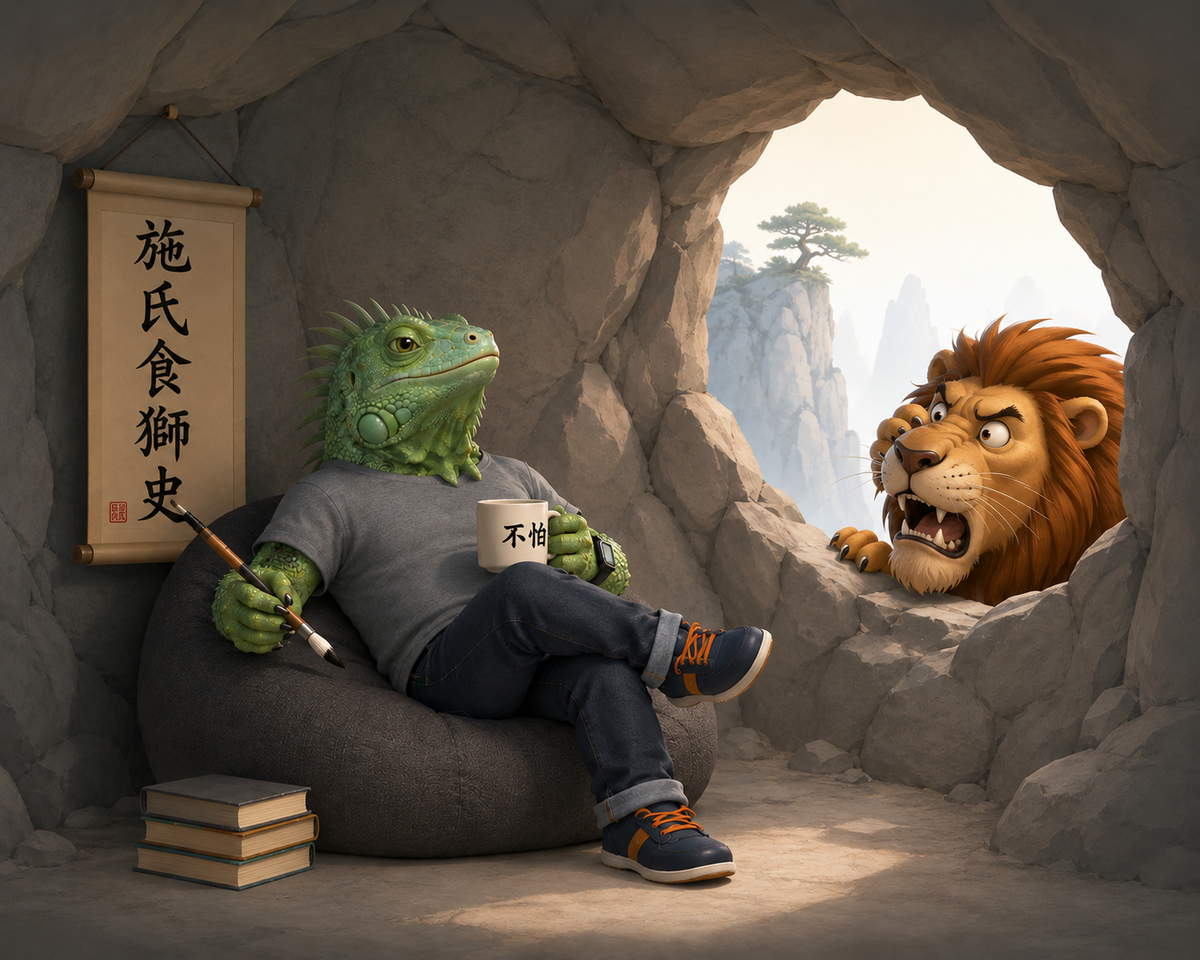
After the previous post about English idioms I was thinking about homophones in Chinese, which I keep learning. The syllable shì immediately came to mind, which means pretty much anything. Well, for instance,
是 世 市 室 事 试 式 示 誓 柿
all of these sound like shì and can mean to be, world, city, room, matter, to try, type, to show, oath, persimmon. And that's just one tone.
If you add the other tones (shī, shí, shǐ), you get no fewer than 40 different common meanings, all written differently but sounding (within a tone) the same. Even the number 10 — 十 — is shí as well.
That alone blows your mind a little, but while digging into how many different words sound like shi, shy or shii, I found this wonderful poem.
石室詩士施氏, 嗜獅, 誓食十獅。
氏時時適市視獅。
十時, 適十獅適市。
是時, 適施氏適市。
氏視是十獅, 恃矢勢, 使是十獅逝世。
氏拾是十獅屍, 適石室。
石室濕, 氏使侍拭石室。
石室拭, 氏始試食是十獅。
食時, 始識是十獅, 實十石獅屍。
試釋是事。
It looks like an ordinary Chinese poem that you or I could read over breakfast, if only we knew how :)
That said, this particular poem is easier to read than others. The thing is, it reads as
Shíshì shīshì Shī Shì, shì shī, shì shí shí shī.
Shì shíshí shì shì shì shī.
Shí shí, shì shí shī shì shì.
Shì shí, shì Shī Shì shì shì.
Shì shì shì shí shī, shì shǐ shì, shǐ shì shí shī shìshì.
Shì shí shì shí shī shī, shì shíshì.
Shíshì shī, Shì shǐ shì shì shíshì.
Shíshì shì, Shì shǐ shì shí shì shí shī.
Shí shí, shǐ shí shì shí shī, shí shí shí shī shī.
Shì shì shì shì.
That is, 92 syllables, and all of them sound like "shi" in different tones!
According to one version, it was written in the early 20th century by the linguist Yuen Ren Chao; according to another, it was written by one Hu Mingfu, and the linguist published it and later refined it. They say this humorous little verse is perfectly grammatical, but for obvious reasons pretty much nobody can understand it by ear.
Russian and English sources translate it a bit differently; here's the English version from Wikipedia:
In a stone den was a poet called Shi Shi, who was a lion addict, and had resolved to eat ten lions.
He often went to the market to look for lions.
At ten o'clock, ten lions had just arrived at the market.
At that time, Shi had just arrived at the market.
He saw those ten lions, and using his trusty arrows, caused the ten lions to die.
He brought the corpses of the ten lions to the stone den.
The stone den was damp. He asked his servants to wipe it.
After the stone den was wiped, he tried to eat those ten lions.
When he ate, he realized that these ten lions were in fact ten stone lion corpses.
Try to explain this matter.
And on video platforms you'll easily find clips of all sorts of people trying to read this poem aloud.
I'll keep learning this wonderful language!