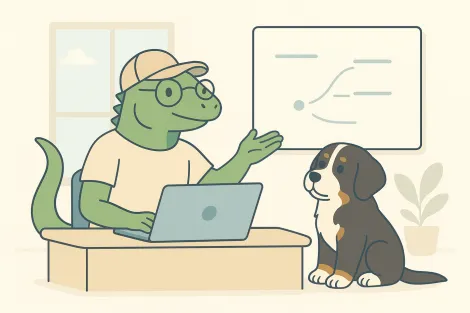
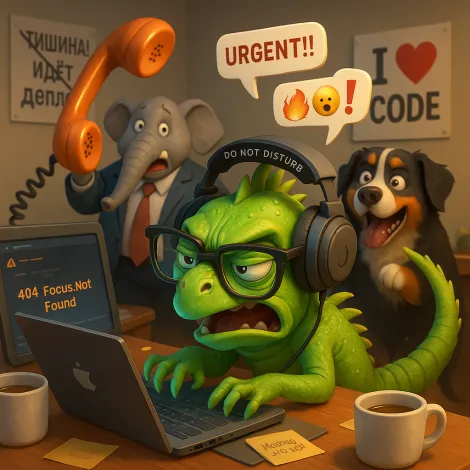
Every action or activity presumably has a purpose. We walk to get somewhere, run to get there faster, rest to regain strength, and click all the crosswalks in pictures to prove we're human. But there is one activity that many developers will confidently call pointless, meaningless and useless, and those who make others do it should be shot punished. I'm talking, of course, about meetings.
But is it really that bad? Actually, no. You can get something useful even out of "bad" meetings, just maybe not what you were hoping for. Besides, the fact that you or I personally didn't find anything useful in a meeting doesn't mean nobody else did. Say, the boss who needs to decide who won't get a bonus this month has already made a note of a couple of sour, uninterested faces.
Over 20 years of work I've of course taken part in all kinds of meetings. And at first many of them followed the same script. The team got together and had a heated discussion of the current project. Lots of ideas and opinions were voiced, it went on for two hours. And then what? Right, then at the next meeting it turned out that almost nobody had done a damn thing of what was said.
However, ten-something years ago I ended up in a working group collaborating with some Brits in the microelectronics industry. And one thing struck me right away. Every meeting call had a moderator, or a secretary, so to speak. He didn't know the answers to most questions himself, but he had the agenda (of his own side, at least), he owned the schedule, he shared his screen and took notes right there in SharePoint. And in these notes he didn't just briefly record what was discussed. But — most importantly — he immediately wrote down the actionables. That is, what action had to be taken as a result of the discussion. And — again, most importantly — who! had to take it.
After the meeting, all participants got access to the notes and the list of actions. And this had a dramatic effect on the results. Just try not reporting on the great successes you've achieved when, a couple of weeks later, you and all your colleagues are called upon to report on what was written down earlier!
This practice stuck with me forever, and I came across it many times later in other projects, mostly international ones. I recommend it to everyone: do it, appoint a secretary, or appoint yourself, keep at least basic minutes, and the output of all that talk will be noticeable. Especially if it wasn't before.
Especially since nowadays there are tools for recording a meeting, if taking notes on the go is inconvenient, and even for transcribing it afterwards.
The process in that group, however, also had a serious drawback, in my opinion. The thing is, when a call had an agenda only from our side, our foreign colleagues sent just the secretary. We voiced our questions, and the answer to them was always the same: I'll check with my colleagues and get back to you. That was very annoying, of course: why on earth did ten of us show up, when the whole session could have been replaced with one email with questions, and the meeting could have been scheduled when the answers were ready.
This also stuck with me, and in my dealings with clients I always stress: there will be no broken telephone with managers on my side. Only a discussion with the person who has first-hand information. That is, with me.
Then for several years I freelanced for an American team, on a highly automated e-commerce project. Which ran on Drupal 6 even when Drupal 9 was already out. I built online accounting automation for them, Stripe and lots of other stuff. The team was remarkable in that it held exactly zero meetings. Everything that needed discussing could be discussed in Slack.
And this had two main perks. First, of course, it's paradise for those who don't like calls. No need to spend time, get interrupted, synchronize. Finished a task — wrote up a thorough report. Second, written communication is always more to the point. If you can't put a thought in writing, it isn't ready yet, think some more. And write it so that the other person understands you. And they write back something you understand. Which, again, saves everyone time.
To be continued.